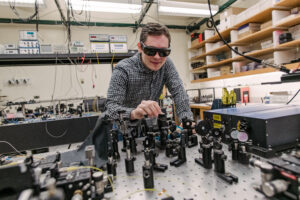
QSI faculty are in the process of designing new cross-disciplinary quantum information science courses, as well as Quantum Information Science and Engineering (QISE) academic tracks within the Physics and CSEE majors.
Current quantum science relevant courses at UMBC include:
CMSC 457/643: Quantum Computing
The course begins with a brief overview of those topics in quantum mechanics and mathematics needed for the understanding of quantum computation. It will then focus on quantum algorithms, covering such topics as quantum superposition and quantum entanglement, quantum decoherence, quantum teleportation, quantum Turing machines, Shor’s Algorithm, Grover’s algorithm, Hallgren’s algorithm, quantum information theory, quantum data compression, quantum cryptographic protocols, quantum error-correcting codes, implementation issues.
The course begins with a brief overview of those topics in quantum mechanics and mathematics needed for the understanding of quantum computation. It will then focus on quantum algorithms, covering such topics as quantum superposition and quantum entanglement, quantum decoherence, quantum teleportation, quantum Turing machines, Shor’s Algorithm, Grover’s algorithm, Hallgren’s algorithm, quantum information theory, quantum data compression, quantum cryptographic protocols, quantum error-correcting codes, implementation issues.
IS 471: Data Analytics for Cybersecurity
This course provides an introduction to data analytics for multiple aspects of cyber security and focuses on data analytics methods for discovering anomalies pertaining to Cyber threats through exercises in programming and hands on data analytics tools. This course includes a module on quantum cryptography and software system security in the era of quantum computing.
This course provides an introduction to data analytics for multiple aspects of cyber security and focuses on data analytics methods for discovering anomalies pertaining to Cyber threats through exercises in programming and hands on data analytics tools. This course includes a module on quantum cryptography and software system security in the era of quantum computing.
MATH 490/710: Quantum Computing Algorithms and Applications
This course provides an introduction to quantum computing, covering core concepts such as qubits, gates, and circuits, along with foundational quantum algorithms: Deutsch’s, Simon’s, Shor’s, Grover’s, Quantum Fourier Transform, and Phase Estimation. The course emphasizes Quantum Linear Algebra, focusing on solving linear systems and eigenvalue problems, with applications in optimization, machine learning, and scientific computing. The focus is on the mathematical and computational foundations of quantum computing, rather than quantum mechanics or hardware.
This course provides an introduction to quantum computing, covering core concepts such as qubits, gates, and circuits, along with foundational quantum algorithms: Deutsch’s, Simon’s, Shor’s, Grover’s, Quantum Fourier Transform, and Phase Estimation. The course emphasizes Quantum Linear Algebra, focusing on solving linear systems and eigenvalue problems, with applications in optimization, machine learning, and scientific computing. The focus is on the mathematical and computational foundations of quantum computing, rather than quantum mechanics or hardware.
PHYS 424: Introduction to Quantum Mechanics
This undergraduate course introduces the breakdown of classical mechanics and the development of quantum theory, the foundations of the Schrödinger equation, the uncertainty principle, quantum systems in one dimension, angular momentum, spin and atomic physics, indistinguishable particles, and quantum entanglement.
This undergraduate course introduces the breakdown of classical mechanics and the development of quantum theory, the foundations of the Schrödinger equation, the uncertainty principle, quantum systems in one dimension, angular momentum, spin and atomic physics, indistinguishable particles, and quantum entanglement.
PHYS 434: Advanced Quantum Mechanics
This undergraduate course covers wavefunctions for the electron in the hydrogen atom, angular momentum operators and operator techniques, time-independent and time-dependent perturbation theory, and the role of identical particles in quantum mechanics. Modern applications in quantum information processing are also investigated.
This undergraduate course covers wavefunctions for the electron in the hydrogen atom, angular momentum operators and operator techniques, time-independent and time-dependent perturbation theory, and the role of identical particles in quantum mechanics. Modern applications in quantum information processing are also investigated.
PHYS 601: Quantum Mechanics 1
This graduate course introduces the advanced concepts, theory and applications of quantum physics, with the emphasis on one-dimensional and multi-dimensional systems, angular momentum, operator methods, harmonic oscillators, hydrogen and helium atoms and spin systems.
This graduate course introduces the advanced concepts, theory and applications of quantum physics, with the emphasis on one-dimensional and multi-dimensional systems, angular momentum, operator methods, harmonic oscillators, hydrogen and helium atoms and spin systems.
PHYS 612: Quantum Information Physics
This course gives an introduction to the fundamental concepts of quantum information processing with an emphasis on the physics of its implementation. The focus is on the nascent field of quantum computing, with some results in quantum communication discussed as well.
This course gives an introduction to the fundamental concepts of quantum information processing with an emphasis on the physics of its implementation. The focus is on the nascent field of quantum computing, with some results in quantum communication discussed as well.
PHYS 701: Quantum Mechanics 2
This graduate course covers advanced topics including Pperturbation theory, interaction of quantum systems with the electro-magnetic field, second quantization, quantization of the electromagnetic field and applications, path integral formulation, scattering theory.
This graduate course covers advanced topics including Pperturbation theory, interaction of quantum systems with the electro-magnetic field, second quantization, quantization of the electromagnetic field and applications, path integral formulation, scattering theory.
PHYS 710: Quantum Optics
This course covers the quantum mechanical treatment of the electromagnetic field. Topics include properties of the electromagnetic field, coherent states, squeezed states, Bloch–Maxwell equations and photon optics.
This course covers the quantum mechanical treatment of the electromagnetic field. Topics include properties of the electromagnetic field, coherent states, squeezed states, Bloch–Maxwell equations and photon optics.